
Indian Rupee ticks lower due to elevated oil prices, recovery in US bond yields
- The Indian Rupee remains under pressure against the US Dollar.
- Both the US and Iran don't seem to be making efforts to resume talks regarding Hormuz reopening.
- The US plan to double down on its bond-buying program could prove to be a temporary solution for higher Treasury yields.
The Indian Rupee (INR) edges down against the US Dollar (USD) in the opening session on Friday. The USD/INR ticks up to near 95.72 as elevated oil prices and a sharp recovery in United States (US) Treasury Yields have weighed on the Indian currency.
In the opening session, the MCX Crude Oil contract expiring on September 21 trades marginally lower at around Rs. 8,285, but is still close to its over three-week high of Rs. 8,404 posted on Thursday.
Currencies from economies, such as India, which rely heavily on oil imports to meet their energy needs, tend to underperform in a high-oil-price environment.
As of writing, 30-year US Treasury Yields hold onto Thursday’s recovery move at around 5.25%. Higher US bond yields diminish the appeal of riskier currencies, such as the Indian Rupee.
Oil prices remain elevated amid US-Iran deadlock
Global oil prices remain at their higher levels as both the US and Iran seem least interested in resuming talks regarding the reopening of the Strait of Hormuz, a critical chokepoint for almost 20% of global energy supply.
On Wednesday, US President Donald Trump warned of measures to isolate Iran from the global financial system and severe economic consequences to nations if seen supporting the nation.
“ANY country that allows its financial institutions, businesses, airports, or government entities to provide any type of lifeline to Iran will itself face TREMENDOUS Economic Consequences. Oil smuggling, swap lines, cash transfers, exchange houses, ship registries, front companies — it all needs to stop NOW. You know who you are,” US President Trump wrote on Truth Social.
According to TD Securities, "energy market tightness persists," with analysts warning that stalled diplomacy and mounting geopolitical frictions are keeping supply risks elevated. They note that "negotiations on hold for weeks and a shift toward economic pressure suggests crude flows in the market will remain critically tight, and Iranian aggression in the Oman lane will likely remain the norm," reinforcing concerns over constrained seaborne exports.
US Treasury Yields rebound on mounting debt concerns
Brown Brothers Harriman’s Elias Haddad highlights that “US long-term Treasury yields have retraced most of yesterday’s drop triggered by the US Treasury’s buyback announcement, while USD has extended its decline.” He explains that “the Treasury buyback is essentially a debt-management swap. The Treasury buys and retires older, less liquid bonds (off-the-run) in favor of new, more liquid debt (on-the-run) issued through its regular auction. Total debt stays the same, but its composition shifts toward newer, more liquid securities.”
According to BBH, “the additional buyback size will probably be financed at the margin through greater bill issuance. More front-end supply combined with long-bond purchases points to a flatter yield curve. However, the impact should be limited given the small size of the operations relative to the overall Treasury market ($31.4 trillion).”
Haddad cautions that “the timing of the Treasury’s buyback announcement sends a less comfortable message. The Treasury expanded the long-end buybacks shortly after the 30-year Treasury yield reached its highest level since 2007. This suggests that heavy debt supply (public and private) is beginning to strain long-end liquidity and the Treasury is increasingly uncomfortable with rising borrowing costs.” In BBH’s view, “bottom line, the perception the Treasury is managing yields rather than liquidity undermines US fiscal credibility and is a drag on USD.”
India’s flash Composite PMI rises at a faster pace
India’s preliminary HSBC Composite Purchasing Managers’ Index (PMI) data for August has come in higher than expected. The Composite PMI arrives at 54.6, higher than estimates of 54.4 and the July reading of 54.3.
A stronger-than-projected increase in service sector activity helped the overall business expand at a faster pace. The Services PMI expanded to 54.5 from 53.3 in July.
The manufacturing sector activity also expanded but at a moderate pace. The Manufacturing PMI came in lower at 52.9 than the prior release of 53.5. It was expected to rise at a faster pace to 54.0.
USD/INR Technical Analysis
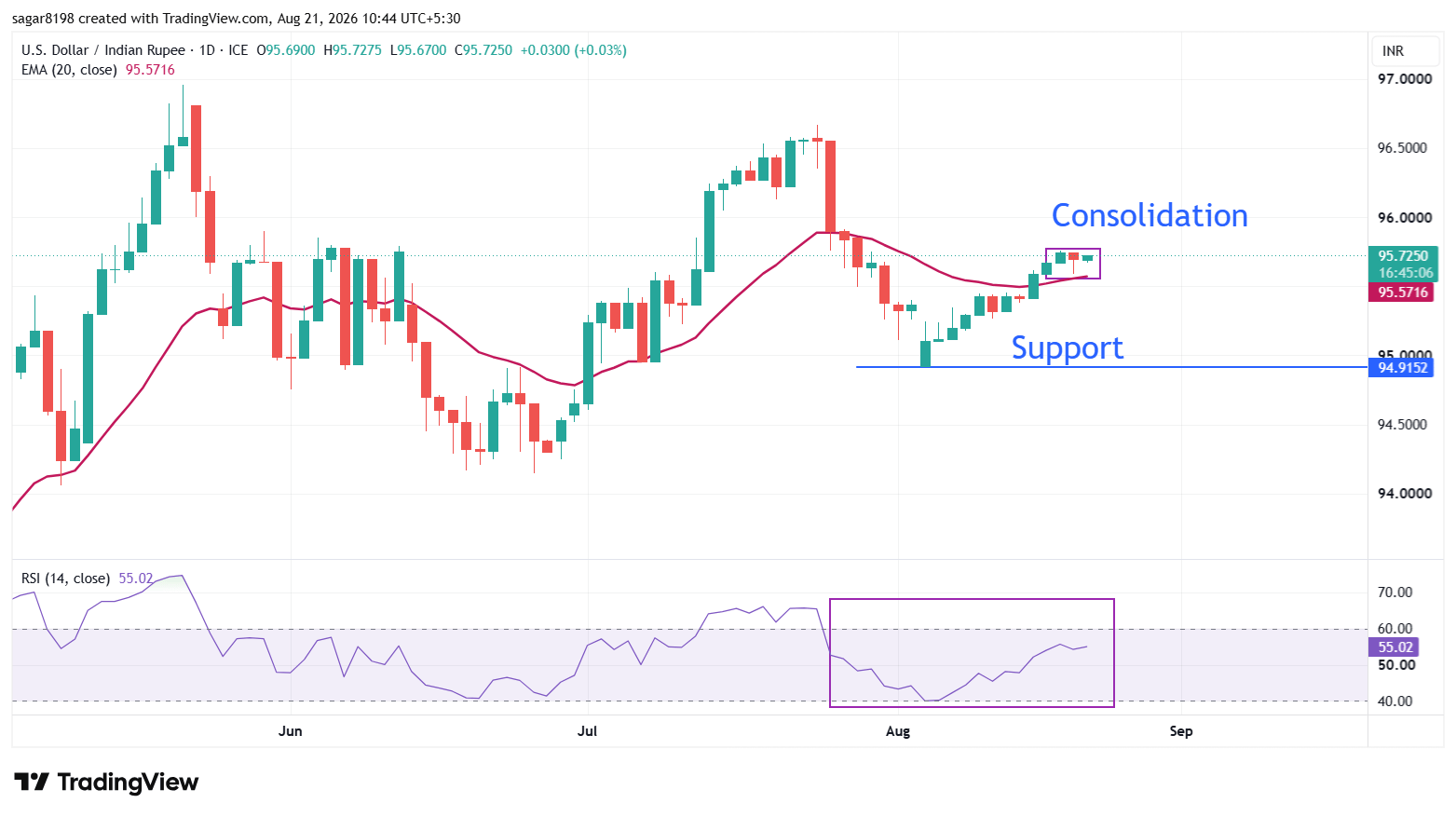
In the daily chart, USD/INR has remained in a range between 95.49 and 95.87 for the past few trading days. The pair holds a mildly bullish near-term bias as price remains above the 20-period exponential moving average (EMA) at 95.57, suggesting underlying demand on dips.
The Relative Strength Index (RSI) at 55 sits just above its midpoint, hinting at modest upward momentum without stretching into overbought territory.
On the downside, immediate support is located at the 20-day EMA around 95.57, where buyers are likely to defend the recent advance. With no clear technical resistance levels provided in the current dataset, upside progress would depend on whether bulls can sustain closes above the short-term average and drive the RSI further into positive territory.
(The technical analysis of this story was written with the help of an AI tool. Know more.)
Indian Rupee FAQs
The Indian Rupee (INR) is one of the most sensitive currencies to external factors. The price of Crude Oil (the country is highly dependent on imported Oil), the value of the US Dollar – most trade is conducted in USD – and the level of foreign investment, are all influential. Direct intervention by the Reserve Bank of India (RBI) in FX markets to keep the exchange rate stable, as well as the level of interest rates set by the RBI, are further major influencing factors on the Rupee.
The Reserve Bank of India (RBI) actively intervenes in forex markets to maintain a stable exchange rate, to help facilitate trade. In addition, the RBI tries to maintain the inflation rate at its 4% target by adjusting interest rates. Higher interest rates usually strengthen the Rupee. This is due to the role of the ‘carry trade’ in which investors borrow in countries with lower interest rates so as to place their money in countries’ offering relatively higher interest rates and profit from the difference.
Macroeconomic factors that influence the value of the Rupee include inflation, interest rates, the economic growth rate (GDP), the balance of trade, and inflows from foreign investment. A higher growth rate can lead to more overseas investment, pushing up demand for the Rupee. A less negative balance of trade will eventually lead to a stronger Rupee. Higher interest rates, especially real rates (interest rates less inflation) are also positive for the Rupee. A risk-on environment can lead to greater inflows of Foreign Direct and Indirect Investment (FDI and FII), which also benefit the Rupee.
Higher inflation, particularly, if it is comparatively higher than India’s peers, is generally negative for the currency as it reflects devaluation through oversupply. Inflation also increases the cost of exports, leading to more Rupees being sold to purchase foreign imports, which is Rupee-negative. At the same time, higher inflation usually leads to the Reserve Bank of India (RBI) raising interest rates and this can be positive for the Rupee, due to increased demand from international investors. The opposite effect is true of lower inflation.