
Gold pauses after two-day recovery as US NFP looms
Gold (XAU/USD) moves quietly on Friday after two straight days of gains, as traders appear reluctant to take fresh positions ahead of the US Nonfarm Payrolls (NFP) report at 12:30 GMT. The metal briefly climbed above $4,500 on Thursday, rising nearly 2% on the back of a softer US Dollar (USD), a modest pullback in Treasury yields and less hawkish remarks from Federal Reserve (Fed) Governor Christopher Waller. At the time of writing, XAU/USD trades around $4,472.
Meanwhile, the US Dollar also steadies after losing about 0.55% on Thursday and slipping below 99.00 to its lowest level in more than a week. The US Dollar Index (DXY), which tracks the Greenback’s value against a basket of six major currencies, trades around 99.11.
The US economy is expected to add 56K jobs in August after shedding 23K in July, while the Unemployment Rate is forecast to hold at 4.1%. Markets will also closely watch wage growth and any revisions to the July payrolls figure, after May and June employment gains were revised down by a combined 103K in the previous report.
Fed Governor Waller said on Thursday he is “finally seeing some signs of disinflation,” adding that the “current rate setting could get us back to 2% inflation.” He also said the “rate decision in September hinges on August inflation” and that “if August inflation data comes in hot, I would consider a rate hike.”
His remarks prompted traders to pare back rate hike bets for the upcoming September 15-16 meeting. According to the CME FedWatch Tool, the odds of a 25-basis-point (bps) rate increase now stand at around 50%, down from roughly 63% before Waller spoke.
A stronger-than-expected NFP report could revive Fed rate hike bets and lift the US Dollar and Treasury yields, weighing on the non-yielding metal. Conversely, another weak payroll reading could strengthen the case for the Fed to keep rates unchanged, helping Gold reclaim the $4,500 mark.
Analysts at OCBC remain “constructive” on Gold, but caution that the near-term path is likely to stay “highly sensitive to Fed repricing.” They highlight that “payrolls tonight may drive the next move in yields and the USD,” while “next week’s CPI and PPI should be more decisive in determining whether the recent disinflation trend is sufficient to keep the Fed on hold.” OCBC experts also note that “geopolitical tensions remain supportive at the margin,” but warn that “higher oil prices are a two-sided risk if they feed back into inflation expectations and yields.”
Technical analysis: Buyers eye 200-day SMA
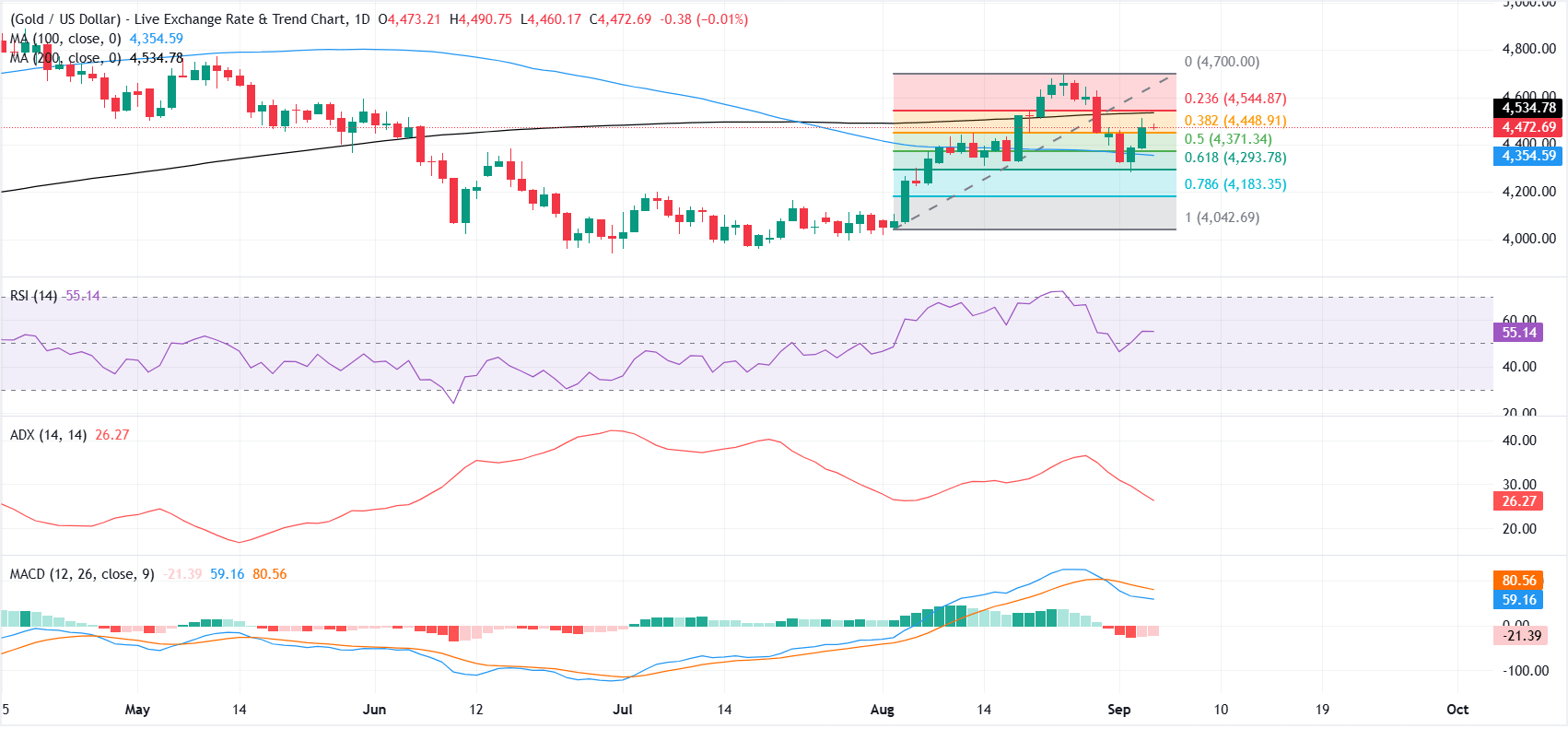
XAU/USD holds above the 100-day Simple Moving Average (SMA) at roughly $4,354 while remaining capped beneath the 200-day SMA near $4,534, leaving the broader tone neutral and consolidative.
Price has reclaimed the 38.2% Fibonacci retracement at about $4,448, turning it into immediate support, yet it has not challenged the 23.6% retracement at $4,544 overhead.
The Relative Strength Index (RSI) on the daily chart around 55 suggests mildly positive momentum, but the Moving Average Convergence Divergence (MACD) remains below zero, hinting that recovery attempts still face supply near the 200-day average.
On the downside, initial support is seen at the 38.2% Fibonacci level around $4,448, followed by the 50.0% retracement at $4,371 and the 100-day SMA near $4,354. A deeper slide would expose the 61.8% retracement at $4,293 and the lower Fibonacci steps at $4,183 and $4,042.
On the topside, bulls need to clear the 200-day SMA near $4,534, with the 23.6% retracement at $4,544 acting as a subsequent cap. A sustained break above these levels would open the path toward the prior swing high area around $4,700.
(The technical analysis of this story was written with the help of an AI tool. Know more.)
Nonfarm Payrolls FAQs
Nonfarm Payrolls (NFP) are part of the US Bureau of Labor Statistics monthly jobs report. The Nonfarm Payrolls component specifically measures the change in the number of people employed in the US during the previous month, excluding the farming industry.
The Nonfarm Payrolls figure can influence the decisions of the Federal Reserve by providing a measure of how successfully the Fed is meeting its mandate of fostering full employment and 2% inflation. A relatively high NFP figure means more people are in employment, earning more money and therefore probably spending more. A relatively low Nonfarm Payrolls’ result, on the either hand, could mean people are struggling to find work. The Fed will typically raise interest rates to combat high inflation triggered by low unemployment, and lower them to stimulate a stagnant labor market.
Nonfarm Payrolls generally have a positive correlation with the US Dollar. This means when payrolls’ figures come out higher-than-expected the USD tends to rally and vice versa when they are lower. NFPs influence the US Dollar by virtue of their impact on inflation, monetary policy expectations and interest rates. A higher NFP usually means the Federal Reserve will be more tight in its monetary policy, supporting the USD.
Nonfarm Payrolls are generally negatively-correlated with the price of Gold. This means a higher-than-expected payrolls’ figure will have a depressing effect on the Gold price and vice versa. Higher NFP generally has a positive effect on the value of the USD, and like most major commodities Gold is priced in US Dollars. If the USD gains in value, therefore, it requires less Dollars to buy an ounce of Gold. Also, higher interest rates (typically helped higher NFPs) also lessen the attractiveness of Gold as an investment compared to staying in cash, where the money will at least earn interest.
Nonfarm Payrolls is only one component within a bigger jobs report and it can be overshadowed by the other components. At times, when NFP come out higher-than-forecast, but the Average Weekly Earnings is lower than expected, the market has ignored the potentially inflationary effect of the headline result and interpreted the fall in earnings as deflationary. The Participation Rate and the Average Weekly Hours components can also influence the market reaction, but only in seldom events like the “Great Resignation” or the Global Financial Crisis.