
Indian Rupee falls further as oil prices regain ground
- The Indian Rupee declines further against the US Dollar due to multiple headwinds.
- A rebound in oil prices and hawkish Fed prospects weighed on the Indian currency.
- US S&P Global PMI unexpectedly expands at a faster pace in September.
The Indian Rupee (INR) extends its losses against the US Dollar (USD) on Thursday. The USD/INR pair jumps to near 95.90 as the Indian currency comes under pressure, with oil prices regaining ground, and firm Federal Reserve (Fed) interest rate hike expectations strengthen the US Dollar further.
In the opening session, the MCX Crude Oil contract expiring on October 19 trades 0.45% lower at around Rs. 8,785, but rebounded strongly on Wednesday after posting a fresh two-week low near Rs. 8,496.
At press time, the US Dollar Index (DXY), which gauges the Greenback’s value against six major currencies, trades firmly near the eight-week high of 101.23.
Oil prices bounce back as Iran vows not to surrender to US
Oil prices draw support from Iranian President Masoud Pezeshkian’s speech at United Nations (US) General Assembly on Wednesday, where he vowed, the Islamic Republic will not surrender to the United States (US).
“They have tested the strength and the steadfastness of Iran and they have learned that Iran cannot be made to surrender,” Iranian President Pezeshkian said.
The statement from Iranian President came after US President Trump said that Washington has mainly two options either to make deal with Iran or annihilate the nation, while pushing back hopes of deal after Mid-term elections.
Higher oil prices bode poorly for currencies from economies, such as India, which rely heavily on oil imports to meet their energy needs.
US Dollar continues to draw strength from hawkish Fed prospects
The US Dollar has been outperforming its peers for almost two weeks as financial markets are increasingly confident that the Fed will deliver more interest rate hikes this year even after raising them in the policy meeting this month.
Strategists at ING highlight that the Fed story is dominant, and the hawkish Fedspeak is enough to keep USD in demand.” They point to comments from Richmond Fed President Thomas Barkin, who “reinforced that message on Tuesday, arguing that a single rate hike may not be enough to bring inflation under control.” ING notes that Barkin “also noted that resilient labour market conditions should keep consumer spending supported, implying that a dovish shift among the hawks may require clearer signs of labour market softening.”
Meanwhile, strong preliminary US S&P Global Purchasing Managers’s Index (PMI) data appears to be backing Fed’s more interest rate hike narrative too.
On Wednesday, the PMI report showed an unexpectedly faster growth in both manufacturing and the service sector activity. The Services PMI arrived at 58.7, higher than 56.5 in August, while it was expected to drop to 56.0. The Manufacturing PMI jumped to 57.0 from the previous reading of 53.9, which was expected to drop to 53.5.
USD/INR Technical Analysis
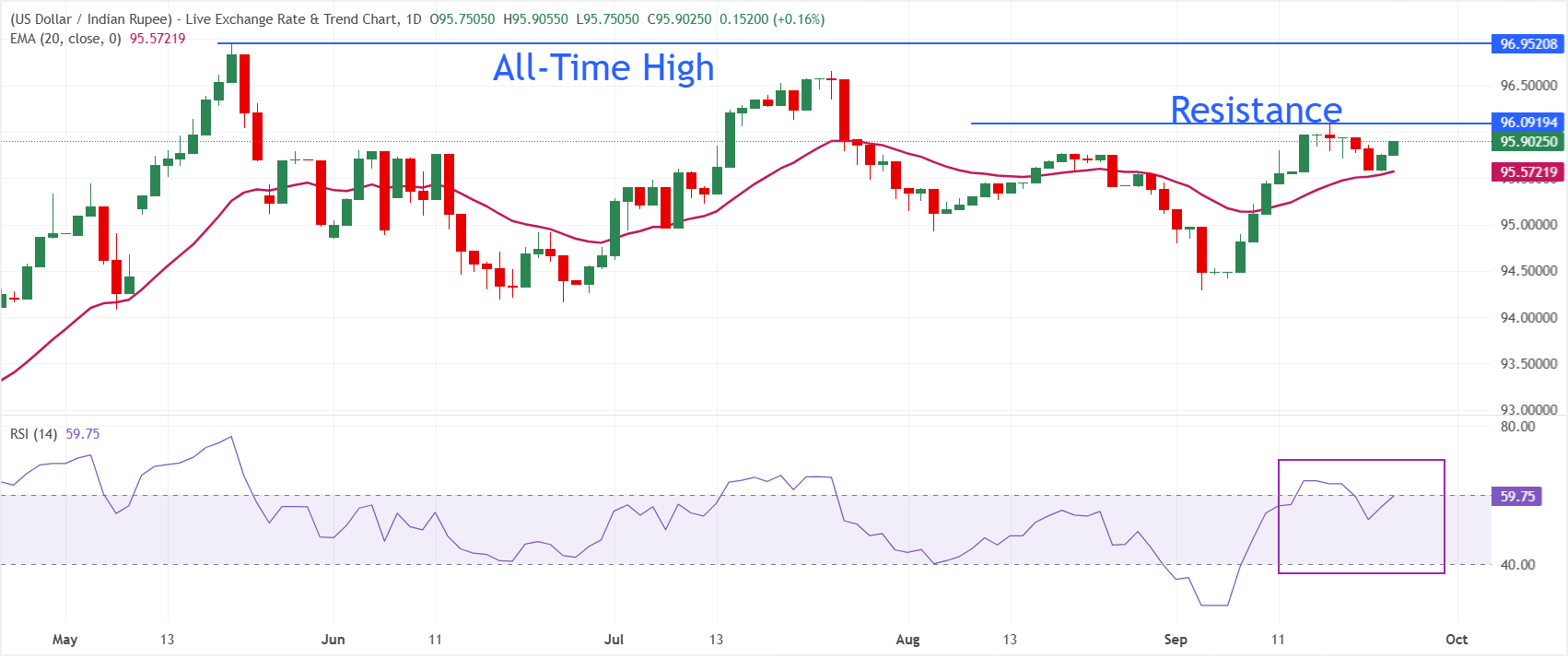
In the daily chart, USD/INR trades at 95.90. The pair holds above the 20-period exponential moving average (EMA) at 95.5722, keeping the near-term bias bullish as price extends its recovery from last week’s lows. Momentum supports the constructive tone, with the Relative Strength Index (RSI) at 59.7, staying in positive territory but still shy of overbought conditions.
On the downside, immediate support is seen at the 20-period EMA at 95.57, which reinforces the bullish backdrop while it holds. Looking up, the immediate hurdle for the pair is the September 17 high at 96.10. The odds of the pair revisiting the all-time high near 97.00 would accelerate if it manages a decisive break above 96.10.
(The technical analysis of this story was written with the help of an AI tool. Know more.)
Indian Rupee FAQs
The Indian Rupee (INR) is one of the most sensitive currencies to external factors. The price of Crude Oil (the country is highly dependent on imported Oil), the value of the US Dollar – most trade is conducted in USD – and the level of foreign investment, are all influential. Direct intervention by the Reserve Bank of India (RBI) in FX markets to keep the exchange rate stable, as well as the level of interest rates set by the RBI, are further major influencing factors on the Rupee.
The Reserve Bank of India (RBI) actively intervenes in forex markets to maintain a stable exchange rate, to help facilitate trade. In addition, the RBI tries to maintain the inflation rate at its 4% target by adjusting interest rates. Higher interest rates usually strengthen the Rupee. This is due to the role of the ‘carry trade’ in which investors borrow in countries with lower interest rates so as to place their money in countries’ offering relatively higher interest rates and profit from the difference.
Macroeconomic factors that influence the value of the Rupee include inflation, interest rates, the economic growth rate (GDP), the balance of trade, and inflows from foreign investment. A higher growth rate can lead to more overseas investment, pushing up demand for the Rupee. A less negative balance of trade will eventually lead to a stronger Rupee. Higher interest rates, especially real rates (interest rates less inflation) are also positive for the Rupee. A risk-on environment can lead to greater inflows of Foreign Direct and Indirect Investment (FDI and FII), which also benefit the Rupee.
Higher inflation, particularly, if it is comparatively higher than India’s peers, is generally negative for the currency as it reflects devaluation through oversupply. Inflation also increases the cost of exports, leading to more Rupees being sold to purchase foreign imports, which is Rupee-negative. At the same time, higher inflation usually leads to the Reserve Bank of India (RBI) raising interest rates and this can be positive for the Rupee, due to increased demand from international investors. The opposite effect is true of lower inflation.